Operations has a specific meaning in mathematics, but for this section I simply mean operation as in ‘things to do to sets’.
Subsets
Subsets are the first time we will encounter a relationship between two sets.
Let A,B be sets. We say A is a subset of B if every element of A is also an element of B. This is notated
A \subseteq B \text{ or } B \supseteq A
If every element of A is an element of B, and A is not equal to B, then A is a proper subset of B, and denoted
A \subset B.
Of course no definition is complete without examples!
Let the following be sets
A = \{a,b,c\} \qquad B = \{a,b\}.
Since every element of B is in A, we have that A \subset B.
If one wanted to prove that two sets were identical, the most common technique is showing that A \subset B, and also that B \subset A, which is only possible if A and B are identical.
If A \subset B and B \subset A, then A = B.
Let A,B and C be sets, then the following statements hold
(Reflexive) A \subset A
(Transitive) If A \subset B and B \subset C, then A \subset C
[TO-DO: Proof on this fact, along with other properties of subsets.]
Powersets
We will now explore a simple function on a set A.
Let A be a set. Then the power set of A, denoted \mathcal{P}(A) is the set of all subsets of A. In set builder notation
\mathcal{P}(A) = \{S \mid S \subset A\}.
Some examples are in order
Let A = \{a,b\}. Then we know the following sets are all subsets of A.
\{\}, \quad \{a\}, \quad \{b\}, \quad \{a,b\}.
So we have that the powerset of A is the set
\mathcal{P}(A) = \{\{\},\{a\},\{b\},\{a,b\}\}.
Let A be a set. Then \mathcal{P}(A) will always contain the empty set, and A itself.
Let A be a finite set containing k elements. Then \mathcal{P}(A) will contain 2^k elements.
This definition however will get a little tricky when thinking about infinite sets. It is easy to count how many subsets exist with a finite number (footnote about dumb philosphical finitist) but it is not clear how, or if, we can take the powerset of an infinite set. It would be quite useful to take the powerset of infinite sets, so we axiomatically define it
For every set A, there exists a power set \mathcal{P}(A).
From the axiom of power set, we know \mathcal{P}(\mathbb{N}) exists, and contains all subsets of \mathbb{N}. Then it contains
\begin{align*}
&\text{All natural numbers: } &&\{0,1,2,3,4,\dots\}\\
&\text{The empty set: } &&\{\}\\
&\text{All even numbers: } &&\{0,2,4,6,8,\dots\}\\
&\text{All odd numbers: } &&\{1,3,5,7,9,\dots\}\\
&\text{The number seven: } &&\{7\}
\end{align*}
And so on. The powerset of \mathbb{N} contains every subset of the natural numbers,
Union
When given two sets, one may wish to refer to the collection of all elements which belong to the set, this is how we define a union.
Let A,B be sets. The Union of A and B is the set of elements either contained in either A or B, and is denoted;
A \bigcup B = \{x \mid x \in A \text{ or } x \in B\}.
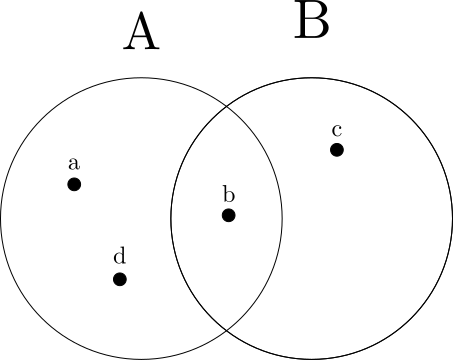
Let A = \{a,b,d\} and B = \{b,c\}. Then the union between the two is
A \bigcup B = \{a,b,c,d\}
As each element is either in A, B, or both. This can be represented with Venn diagrams as such.
Ordered pairs and Cartesian Products
We previously mentioned that sets were unordered due to the principle of extensionality. But let’s say you needed some way to say that an element in a set comes first. This is where ordered pairs come in.
Let a,b be sets. The ordered pair (a,b) is defined by:
(a,b) = \{\{a\},\{a,b\}\}.
This allows us to separate the elements a and b, and fulfills the important property that (a,b) \not = (b,a).
Let (a,b) and (x,y) be ordered pairs. Then (a,b) = (x,y) if and only if a = x and b = y.